
Kroatien, Der Hafen von Veštar 2011 - "... Ausgrabung, Ausstellung, Tagung"
Nach 2010 hatten auch 2011 wieder sechs unserer Mitglieder die Gelegenheit an einer Ausgrabung in der Bucht von Veštar teilzunehmen. Grabungsleiter war erneut Luka Bekić, der nach seinem Wechsel vom Hrvatski restauratorski zavod Leiter des International Centre for Underwater Archaeology in Zadar (ICUA) geworden war.
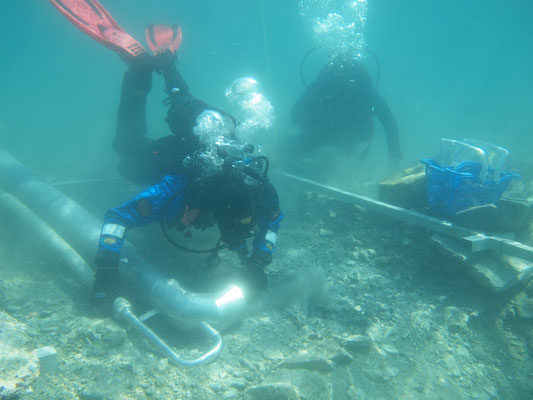
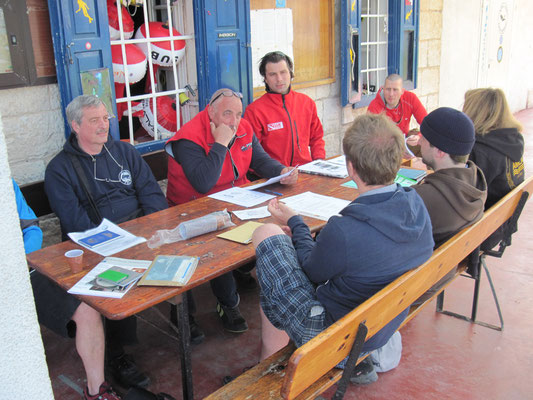
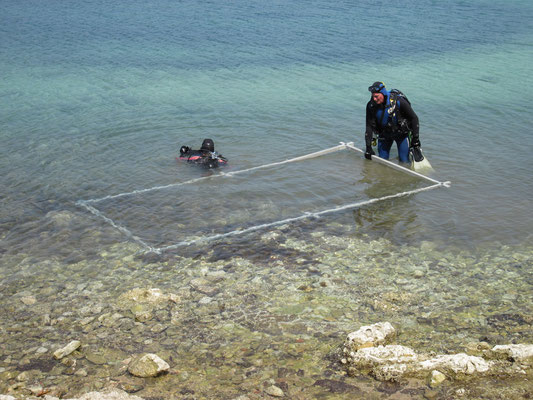
Ziel der diesjährigen Kampagne war das Erreichen des gewachsenen Boden in beiden Sondageschnitten. Nach einer Vorbesprechung der teilnehmenden BGfU-Mitglieder (Mario Bloier, Tobias Pflederer, Axel Sabisch, Dietlind Paddenberg, Richgard Schnell, Thomas Reitmaier) ging es am 17. April nach Kroatien in unser bekanntes Quartier in Jursići. An den ersten beiden Tagen mussten die Abdeckplanen entfernt werden, die am Ende der letztjährigen Kampagne die beiden Sondageschnitte vor Erosion und Schatzgräbern schützen sollten. Glücklicherweise waren die Seitenwände nahezu unversehrt, so dass bereits im Lauf des zweiten Tages mit dem Abflachen der rückwärtigen Wand begonnen werden konnte. Bei einer relativen Wandhöhe von annähernd 2 Metern war dies nötig, um die letzten Schichten zum gewachsenen Boden einfacher abtragen zu können. Leider gelang es nicht, diesen bis zum Ende der gemeinsamen Kampagne zu erreichen. Die kroatischen Kollegen, die eine Woche länger blieben, schafften es jedoch letztendlich. Die 2008 begonnene Grabung, die als Ziel die Erfassung und Datierung der römischen Mole hatte, kann als erfolgreich abgeschlossen betrachtet werden. Die jüngsten Funde datieren den Bau der Molenanlage in die erste Hälfte des 1. Jahrhunderts n. Chr. und damit deutlich früher, als die Funde an Land dies vermuten ließen. So sind wir dem Geheimnis der Bucht von Veštar und der Vorgängersiedlung Rovinjs etwas näher gekommen. Gänzlich gelöst wird es wohl erst nach weiteren Kampagnen sein.
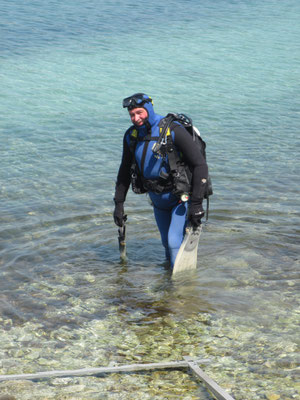
Am letzten Grabungstag, dem 23. April, begaben wir uns noch auf die Suche nach vermeintlichen versunkenen Anlagen in der Nähe der kleinen, vorgelagerten Insel. Ein letzter Tauchgang, bei dem wir nochmals die Unterwasserwelt der Adria in vollen Zügen genießen konnten, ohne jedoch entsprechende Anzeichen zu entdecken. Die Rückfahrt erfolgte am 24. April.
Natürlich bestand der Aufenthalt nicht nur aus Tauchgängen, Unterwasserarbeiten und Fundzeichnungen. Bei traumhaftem Wetter und angenehmen Temperaturen wurden die 2010 geknüpften Freundschaften weiter gepflegt. Das obligatorische Grabungsfest am 22. April - diesmal gab´s selbstgemachtes risotto nero mit Calamari, wildem Spargel und gegrilltem Fisch - bildete wieder den Höhepunkt der gemeinsamen Arbeiten. Daneben fanden auch Ausflüge nach Pula und Rovinj statt, bei denen die örtlichen Sehenswürdigkeiten in einen historischen Kontext zum Grabungsareal gebracht werden konnten.
Am 1. Juli 2011 wurde im Heimatmuseum der Stadt Rovinj feierlich eine Ausstellung über die Ergebnisse der Grabungen der Jahre 2008-2010 eröffnet. Dabei wurde eine kleine Begleitveröffentlichung zur Ausstellung präsentiert, welche die Funde und die bisherigen Unterwasserarbeiten vorstellte. Sie entstand in Zusammenarbeit von Mitgliedern des ICUA und der BGfU und wurde mit Mitteln des Museums gefördert.
Sogar auf der IKUWA 4-Tagung (29. September bis 2. Oktober 2011) in Zadar / Kroatien stand unser gemeinsames Projekt auf dem Programm. Am 30. September 2011 berichteten L. Bekić und M. Pesić in ihrem Vortrag (Bay of Veštar site and the management of the project) über den derzeitigen Ergebnisstand und die weiteren Planungen.
2012 soll es in Veštar weitergehen. Nachdem der gewachsene Boden erreicht wurde, gilt die volle Aufmerksamkeit der Suche nach der spätantik-byzantinischen Mole, die nach der bisher untersuchten, ab dem 3. bis wohl ins 7. Jahrhundert n. Chr. bestand und die große Siedlung an Land mit dem Handel in der Adria verband. Daneben scheinen die vielen Funde an Feinkeramik des 15.-18. Jahrhunderts anzudeuten, dass die Bucht von Veštar auch zu dieser Zeit einen Knotenpunkt des Handels bildete. Anlegestellen sind bisher auch für diese Zeit nicht bekannt. So wird die Kampagne 2012 wohl größtenteils einem survey der Bucht und der Bearbeitung der Funde der letzten Kampagne gelten.
Abschließend ist anzumerken, dass auch die diesjährige Kampagne ein voller Erfolg war. Das neu gebildete bayerische Team konnte problemlos an die letztjährigen Erfolge anschließen und erneut eine enge Gemeinschaft bilden. Die Mitarbeit an einem international angesehenen Projekt, das nicht nur mit einem Vortrag auf der IKUWA, sondern auch einer eigenen Publikation und Ausstellung glänzte, ist für alle Beteiligten ein Zeichen der Anerkennung und Wertschätzung. Für die BGfU ist es ein weiterer Beweis, dass wir den richtigen Weg gehen.
Mario Bloier





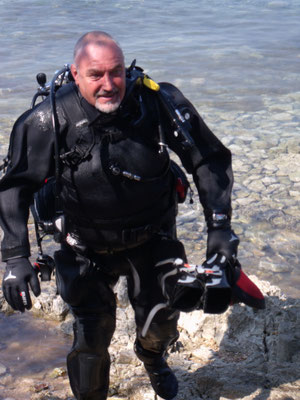


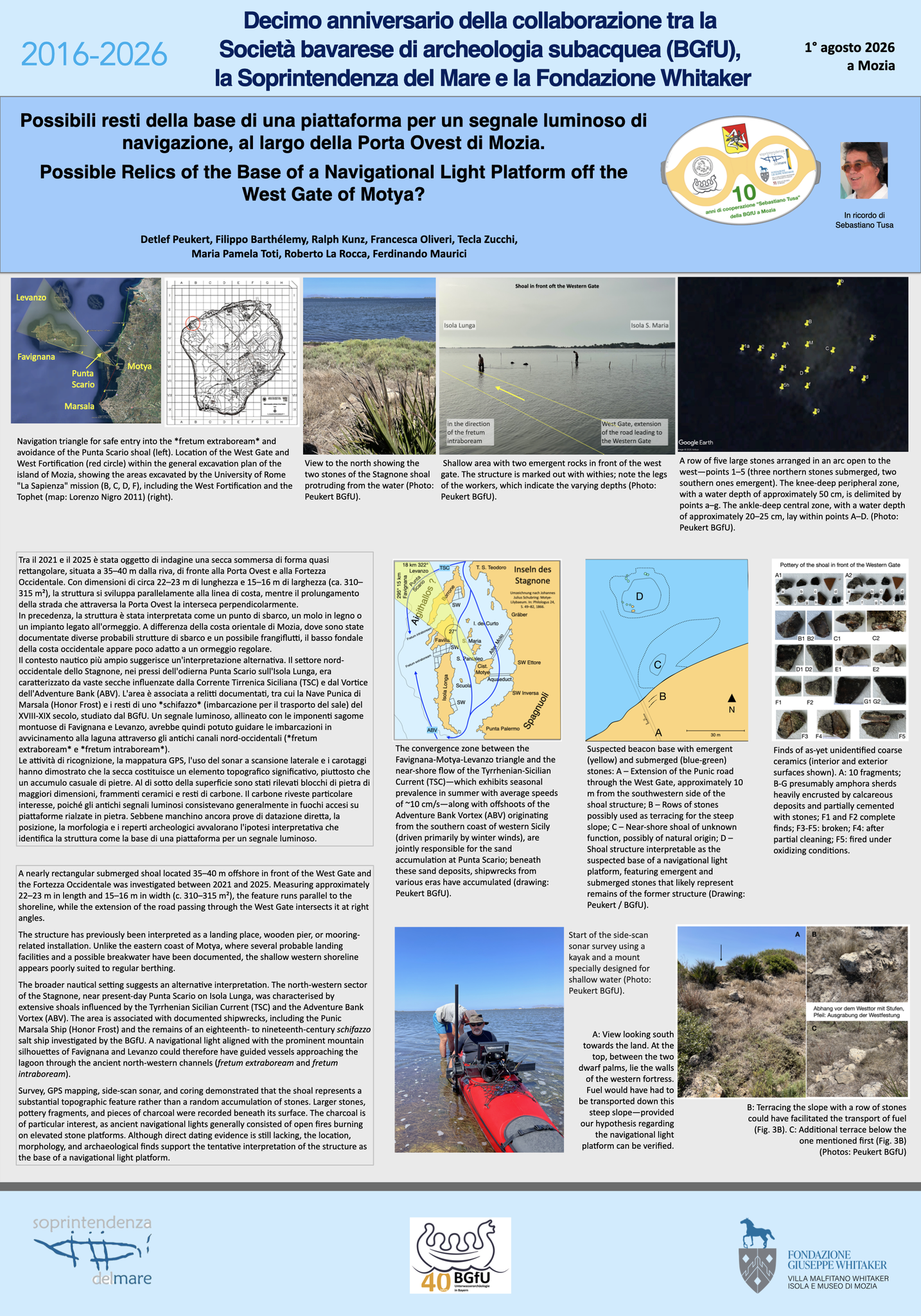
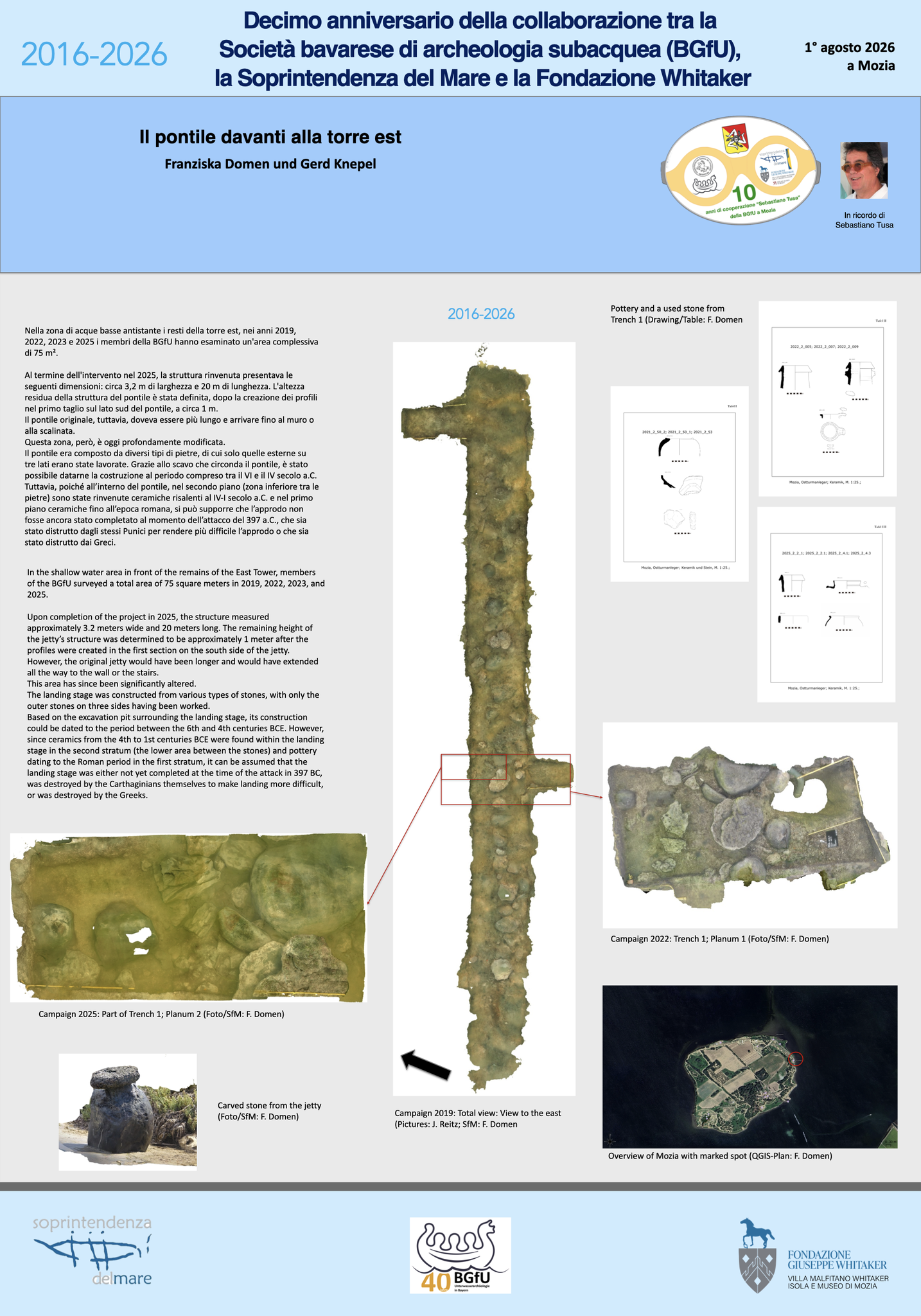
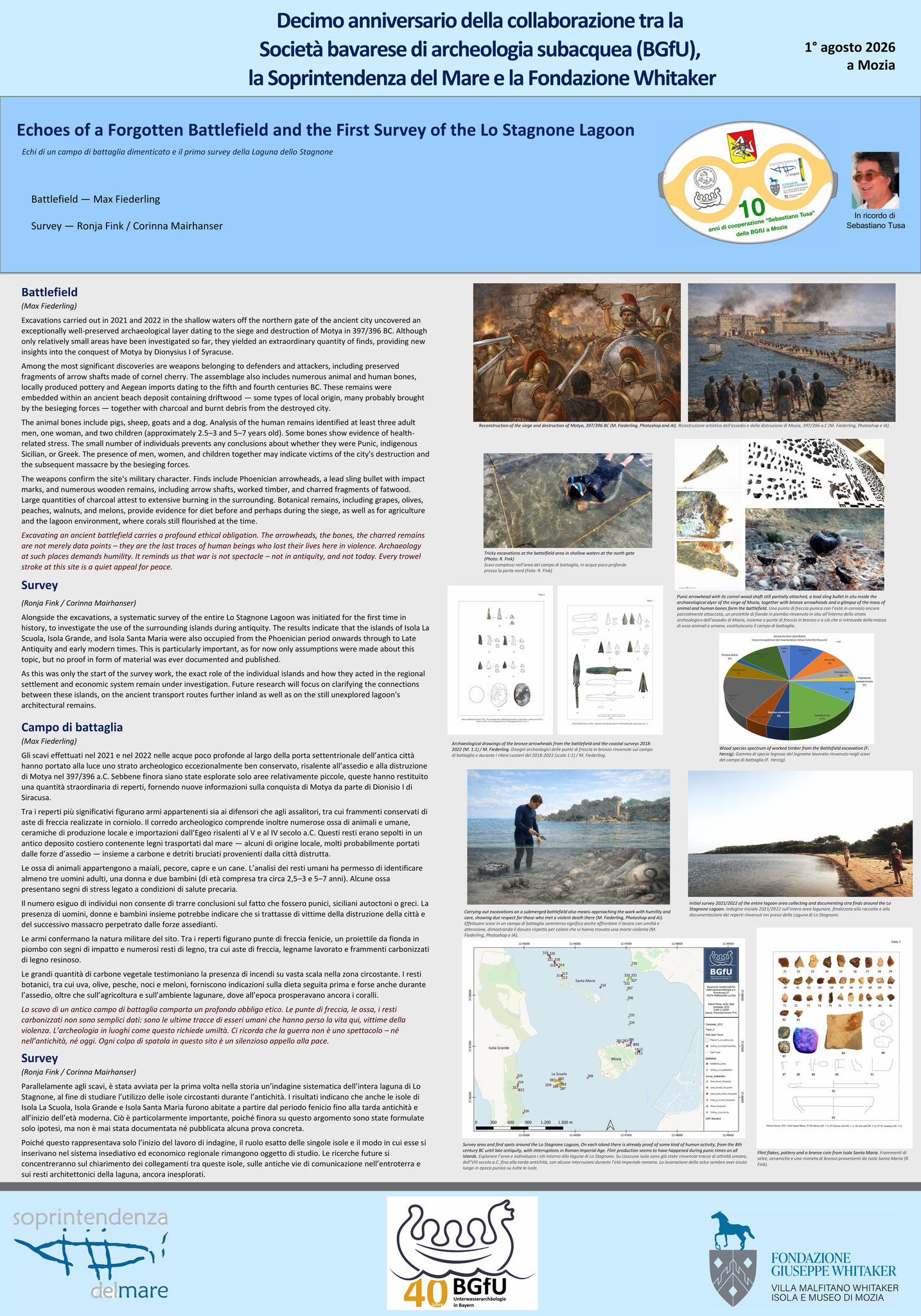
Save the date! 10 Jahre Forschung auf Mozia, Sizilien

Zu Ehren von Sebastiano Tusa veranstalten wir im Rahmen unserer diesjährigen Kampagne eine Feier mit dem Titel:
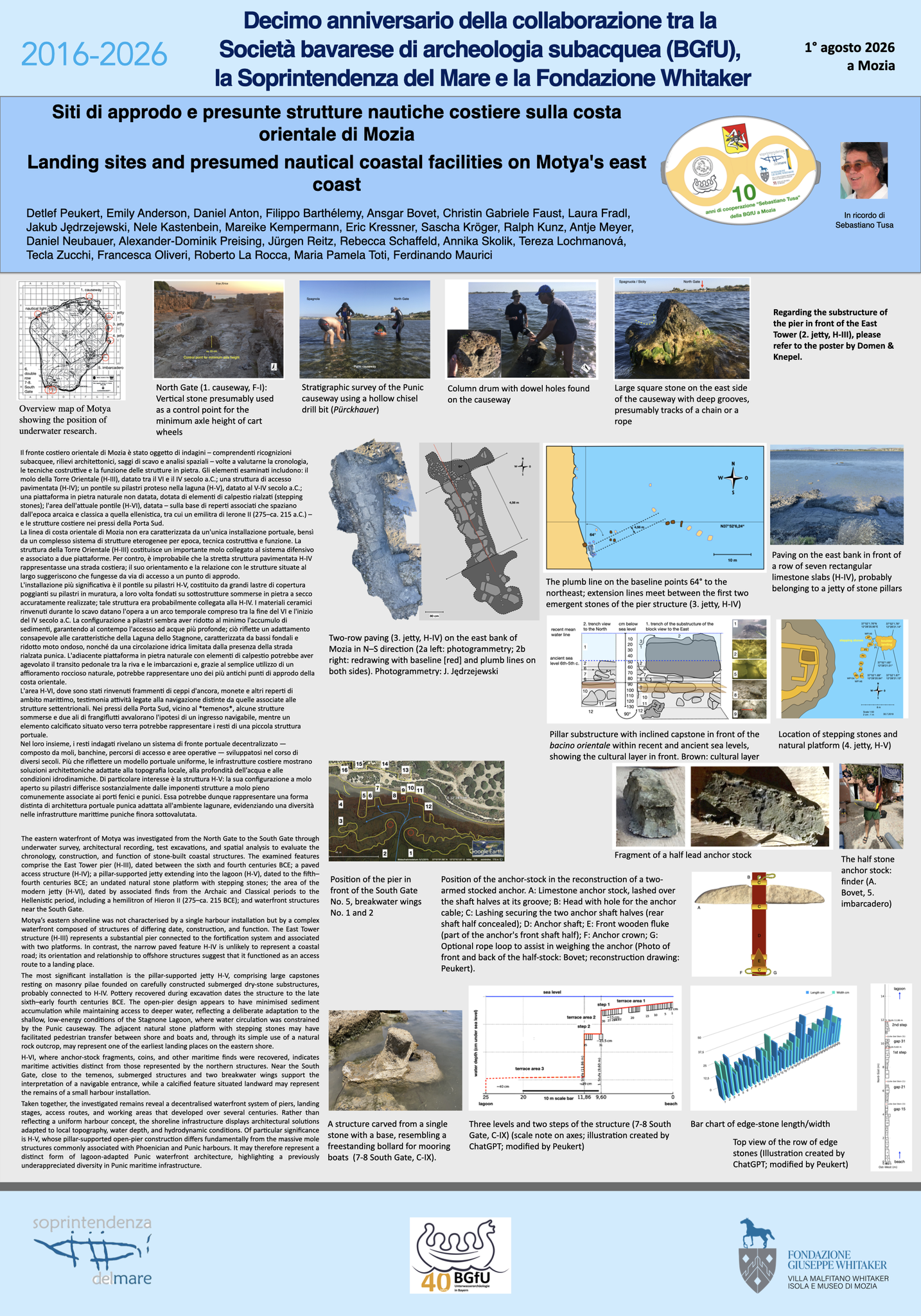
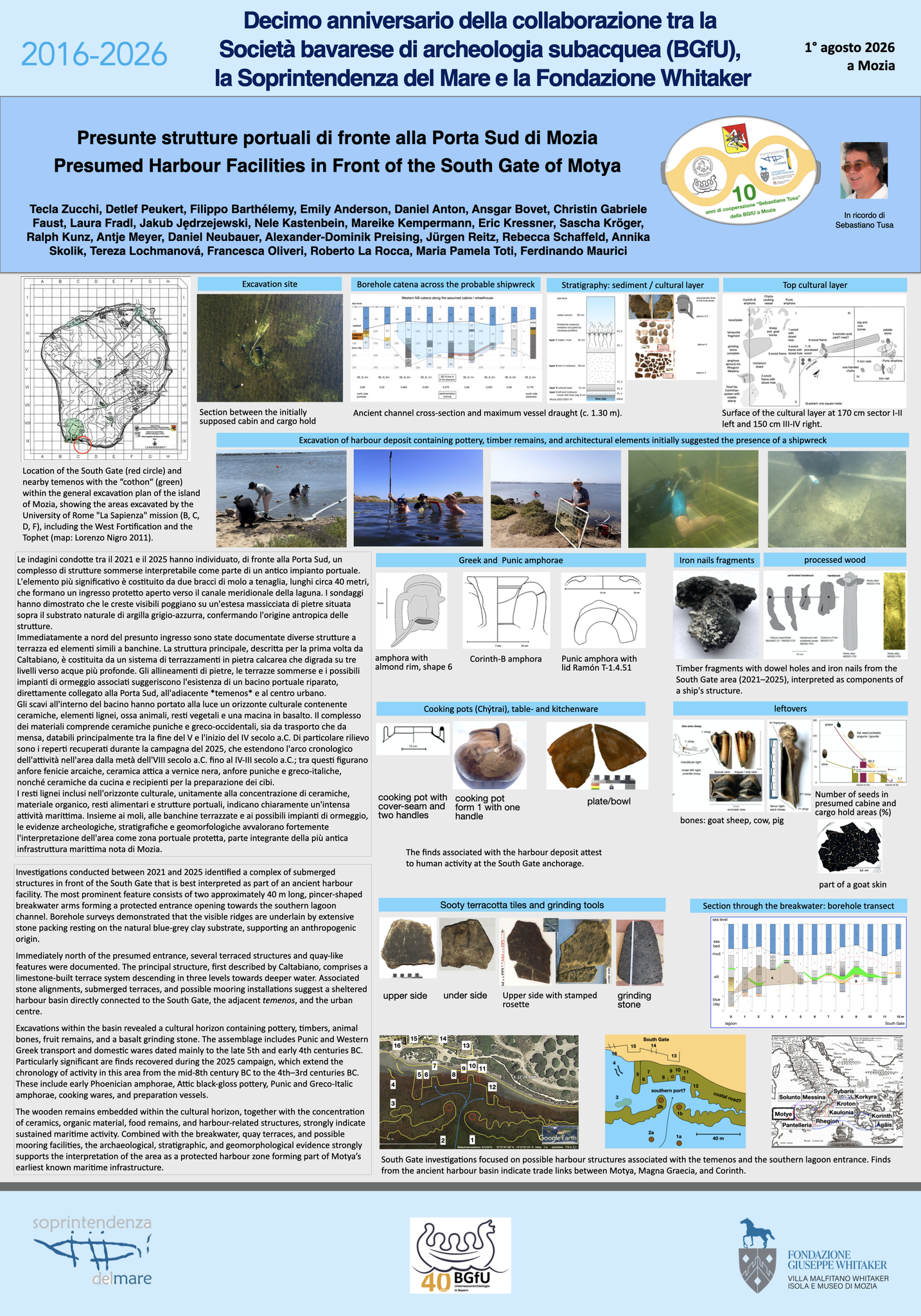
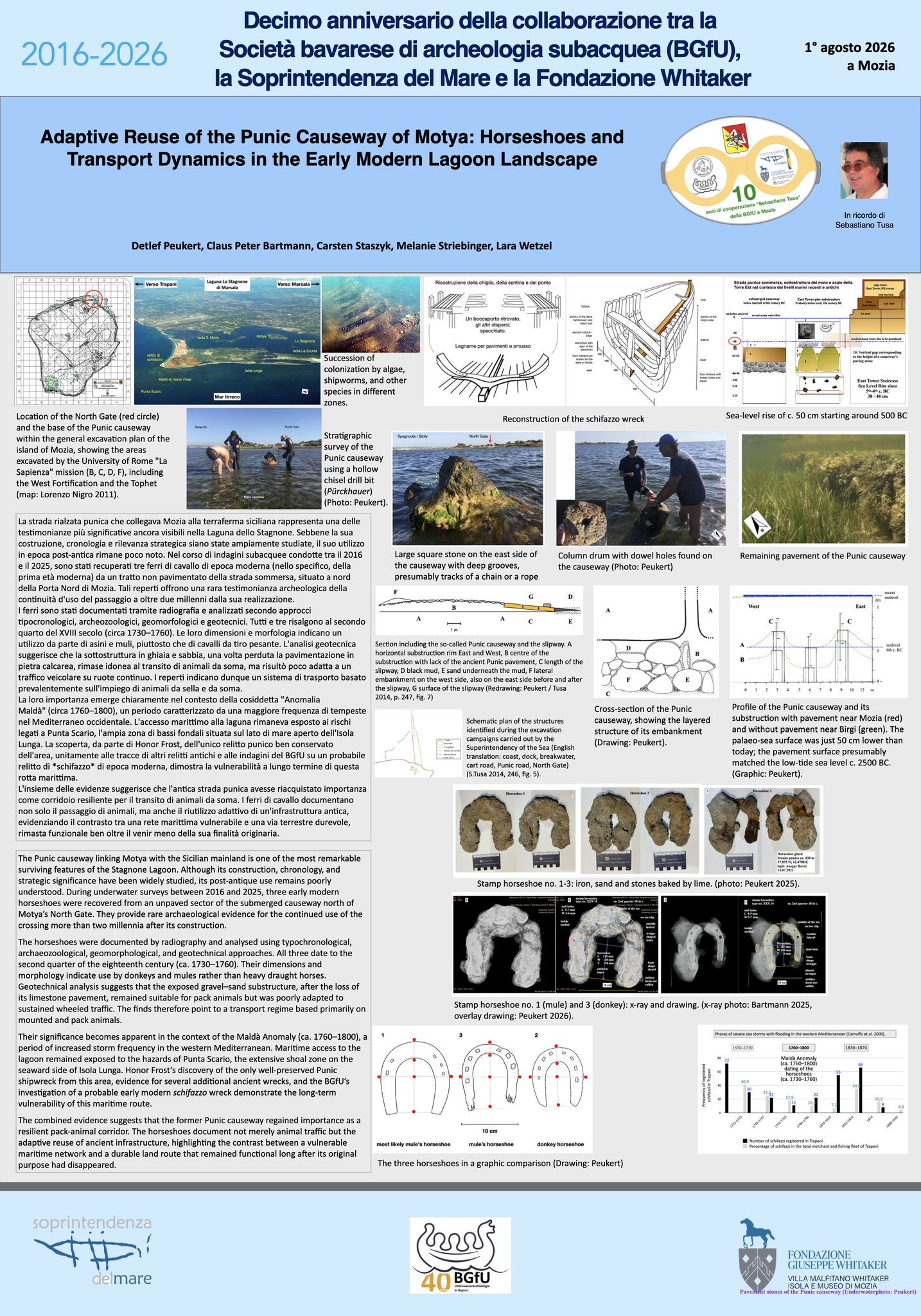
„10 Jahre internationale Zusammenarbeit in der Unterwasserarchäologie“
Die Feier findet am
Samstag, den 1. August 2026, im
neuen Konferenzsaal auf der Insel Motya
statt.
15:30 Uhr: Eröffnung und Begrüßung durch dott.ssa Francesca Oliveri
Vortrag:
- Detlef Peukert „10 Jahre Zusammenarbeit auf Motya“
- Dr. Max Fiederling/Ronja Fink „Das Schicksal der Bewohner von Motya“
- Franziska Domen „Der Steg vor dem Ostturm“
- Tecla Zucchi „Der vermutete Südhafen“
17:30 Uhr: Garten Bet Banat: Aperitif und Abendessen
19:00 Uhr: Workshop von Marlene Schmucker: „Archäologische Restaurierung von Keramik“
20:00 Uhr: Besichtigung unserer Grabungsstellen mit Erläuterungen mit dem Boot und Rückfahrt ans Festland


Acknowledgements
We extend our sincere gratitude to the many individuals and institutions whose generous support, expertise, and encouragement have made this project possible.
The Honor Frost Foundation is supporting, through a Small Grant, the events marking the tenth anniversary of the international collaboration between the Bavarian Society for Underwater Archaeology (BGfU), the Soprintendenza del Mare della Regione Siciliana, and the Fondazione Giuseppe Whitaker. These celebrations will take place on Mozia on August 1, 2026, and will include the presentation of the results of this research. The Foundation’s generous financial support has enabled our research, fieldwork, post-excavation analyses, and the preparation of publications. We are deeply grateful for this invaluable support.
We express our sincere appreciation to the Soprintendenza del Mare della Regione Siciliana for its longstanding collaboration and for continuously supporting our investigations in the Stagnone Lagoon.
Special thanks are due to Prof. Dr. Sebastiano Tusa, whose vision and commitment to underwater archaeology laid the foundation for this long-term cooperation. His untimely death in the Ethiopian Airlines Flight 302 disaster in 2019 deprived Mediterranean archaeology of one of its leading figures. We remember him with profound gratitude as an
inspiring teacher, a valued colleague, and a dear friend.
We are also deeply grateful to Dr. Francesca Oliveri and Dr. Maria Pamela Toti for their steadfast support of the project and for the many stimulating discussions that have greatly contributed to our understanding of the maritime cultural landscape of the Stagnone Lagoon.
Our heartfelt thanks go to Director General Architect Girolama Fontana, Former Superintendent for Cultural and Environmental Heritage in Trapani and member of the Board of Directors of the Whitaker Foundation, as well as to Dott.ssa Maria Enza Carollo, Ex-Direttore Segretario generale della Fondazione Whitaker, the Fondazione Giuseppe Whitaker, and the staff of the Museo Whitaker on Mozia for their longstanding hospitality, generosity, and logistical support throughout many years of fieldwork.
We also thank the inhabitants of Mozia, especially Filippo, for transporting our equipment to the island, and the Kitchen Team of Vita for preparing excellent meals throughout our field campaigns.
We are equally grateful to the officers and crew of the ROAN (Reparto Operativo Aeronavale) of the Guardia di Finanza, especially the divers Raffaele Tucci, Simone Colucci, Pietro Vitello, and Riccardo Nobile. Their professional assistance, together with the transport and logistical support they provided, has consistently enabled our underwater
investigations, often under demanding field conditions. We are indebted to Captain Antonio Anemone and Commander Colonel Moris Ghiadoni of the Aeronautica Militare (37th Wing, Trapani) for granting permission to use a drone for
scientific purposes in the Marsala Lagoon, and to Jürgen Reitz BA, who served as drone pilot and produced our aerial photographs of Motya’s coastline.
We would also like to thank Marlene Schmucker, Archaeological Restaurator B.A., Leibniz- Zentrum für Archäologie (LEIZA), for wood conservation and pottery restoration.
Our sincere thanks also go to Christian Eckmann, Head of Competence Area Restoration, Conservation and Material Analysis and Deputy Director General, and Markus Wittköpper, Archaeological Restorer with a Focus on Wet Wood Conservation, of the Museum für Antike Schiffahrt Mainz for the conservation of our timbers.
We are furthermore grateful to Franz Herzig, Dendrochronologe of the Bayerisches Landesamt für Denkmalpflege, Referat B V – „Bewegliche Denkmäler und Dendrolabor“, for the dendrochronological dating of our wood finds, and to Werner Schoch, Labor für quartäre Hölzer, Laboratory for Ancient Wood, Langnau a. A., Switzerland, for determining the wood species represented in our finds.
Special thanks are due to Prof. Dr. Carsten Staszyk (Justus Liebig University Giessen) for his assistance in identifying animal bones, and to Prof. Dr. Claus Peter Bartmann for producing X-rays of the horseshoes. We are especially grateful for the practical support provided by the training forge at the Equine Clinic in Giessen and for the assistance of Ms. M. Striebinger, farrier instructor and publicly appointed and sworn farrier. Our sincere thanks also go to Prof. Dr. Winfried Held for introducing us to the ancient Mediterranean world through his seminars and lectures, and to the guest lecturers Prof. Dr. Ralph K. Pedersen (USA), Prof. Dr. Marcus Heinrich Hermanns (D), Prof. Dr. Boris Rankov (UK), Prof. Dr. Jeffrey G. Royal (USA), Prof. Dr. Carlos de Juan Fuertes (E), Prof. Dr. Irena Radić Rossi (HR), and Prof. Dr. Harun Özdaş (TR) for their advice on
fundamental questions of nautical archaeology, for an unforgettable diving excursion into the Bay of Gökova from Bodrum (Turkey) aboard the sailing ship Bodrum, and for the opportunity to study this discipline at the University of Marburg/Lahn, Germany.
We also wish to express our gratitude to Prof. Dr. Andreas Müller-Karpe and Prof. Dr. Félix Teichner for their valued scientific advice, for providing the opportunity to present our work in their colloquium, for the many collegial discussions, and, not least, for the enriching personal conversations that accompanied the project.
The organizers of the celebrations marking the tenth anniversary of the excavations also wish to thank all members of the Bavarian Society for Underwater Archaeology (BGfU), as well as the participating divers, students, and volunteers, whose dedication, enthusiasm, and countless hours of fieldwork over many years have formed the foundation of this
project.
Finally, we extend our deepest thanks to our families for their patience, encouragement, understanding, and unwavering support throughout the many years required to bring this project to completion.
Ringraziamenti
Desideriamo esprimere la nostra più sincera gratitudine alle numerose persone e istituzioni il cui sostegno, la cui competenza e il cui incoraggiamento hanno reso possibile questo progetto.
La Honor Frost Foundation, attraverso uno Small Grant, sostiene le iniziative organizzate in occasione del decimo anniversario della cooperazione internazionale tra la Bayerische Gesellschaft für Unterwasserarchäologie (BGfU), la Soprintendenza del Mare della Regione Siciliana e la Fondazione Giuseppe Whitaker. Le celebrazioni si terranno a Mozia il 1° agosto 2026 e comprenderanno la presentazione dei risultati di questa ricerca. Il generoso sostegno finanziario della Fondazione ha reso possibile lo svolgimento delle nostre ricerche, delle attività sul campo, delle analisi post-scavo e della
preparazione delle pubblicazioni. Esprimiamo la nostra più profonda riconoscenza per questo prezioso contributo.
Rivolgiamo il nostro sincero ringraziamento alla Soprintendenza del Mare della Regione Siciliana per la lunga e proficua collaborazione e per il costante sostegno alle nostre indagini nella Laguna dello Stagnone.
Un ringraziamento del tutto speciale va al Prof. Dr. Sebastiano Tusa, la cui visione e il cui instancabile impegno per l'archeologia subacquea hanno posto le basi di questa cooperazione di lunga durata. La sua prematura scomparsa nel disastro aereo del volo Ethiopian Airlines 302 nel 2019 ha privato l'archeologia del Mediterraneo di una delle sue
figure più autorevoli. Lo ricordiamo con profonda gratitudine come maestro ispiratore, stimato collega e caro amico.
Desideriamo inoltre esprimere la nostra viva riconoscenza alla Dr. Francesca Oliveri e alla Dr. Maria Pamela Toti per il loro costante sostegno al progetto e per i numerosi e stimolanti confronti scientifici che hanno contribuito in modo determinante ad approfondire la conoscenza del paesaggio culturale marittimo della Laguna dello Stagnone.
I nostri più sentiti ringraziamenti sono rivolti al Direttore Generale Architetto Girolama Fontana, già Soprintendente per i Beni Culturali e Ambientali di Trapani e membro del Consiglio di Amministrazione della Fondazione Whitaker, nonché alla Dott.ssa Maria Enza Carollo, già Direttore Segretario Generale della Fondazione Whitaker, alla Fondazione Giuseppe Whitaker e al personale del Museo Whitaker di Mozia per la loro pluriennale ospitalità, la costante disponibilità e il prezioso supporto logistico fornito nel corso di molti anni di attività sul campo.
Ringraziamo inoltre gli abitanti di Mozia, in particolare Filippo, per il trasporto delle nostre attrezzature sull'isola, nonché il Kitchen Team di Vita per aver preparato, con grande cura, gli eccellenti pasti che hanno accompagnato le nostre campagne di ricerca.
Esprimiamo inoltre la nostra più sincera gratitudine agli ufficiali e agli equipaggi del ROAN (Reparto Operativo Aeronavale) della Guardia di Finanza, in particolare ai sommozzatori Raffaele Tucci, Simone Colucci, Pietro Vitello e Riccardo Nobile. La
loro competenza professionale, unita ai servizi di trasporto e al costante supporto logistico, ha reso possibile lo svolgimento delle nostre ricerche subacquee, spesso in condizioni operative particolarmente impegnative. Siamo inoltre profondamente riconoscenti al Capitano Antonio Anemone e al Comandante Colonnello Moris Ghiadoni dell'Aeronautica Militare (37° Stormo,
Trapani) per aver concesso l'autorizzazione all'impiego di un drone per finalità scientifiche nella Laguna di Marsala, nonché a Jürgen Reitz BA, che, in qualità di pilota del drone, ha realizzato le fotografie aeree della costa di Mozia.
Desideriamo inoltre ringraziare Marlene Schmucker, Archaeological Restaurator B.A. presso il Leibniz-Zentrum für Archäologie (LEIZA), per il prezioso lavoro di conservazione dei reperti lignei e di restauro dei materiali ceramici.
Esprimiamo altresì la nostra sincera gratitudine a Christian Eckmann, Head of Competence Area Restoration, Conservation and Material Analysis and Deputy Director General, e a Markus Wittköpper, Archaeological Restorer with a Focus on Wet Wood Conservation del Museum für Antike Schiffahrt Mainz, per la conservazione dei nostri reperti lignei.
Siamo inoltre grati a Franz Herzig, Dendrochronologe del Bayerisches Landesamt für Denkmalpflege, Referat B V – „Bewegliche Denkmäler und Dendrolabor“, per la datazione dendrocronologica dei reperti lignei, e a Werner Schoch, Labor für quartäre Hölzer, Laboratory for Ancient Wood, Langnau a. A., Switzerland, per la determinazione delle specie legnose dei nostri reperti.
Un sentito ringraziamento va inoltre al Prof. Dr. Carsten Staszyk (Justus Liebig University Giessen) per il suo prezioso aiuto nell'identificazione dei resti faunistici, e al Prof. Dr. Claus Peter Bartmann per la realizzazione delle radiografie dei ferri di cavallo.
Siamo particolarmente riconoscenti per il sostegno pratico fornito dalla training forge at the Equine Clinic in Giessen e per la collaborazione della Ms. M. Striebinger, farrier Instructor and publicly appointed and sworn farrier.
Il nostro più sincero ringraziamento va inoltre al Prof. Dr. Winfried Held per averci introdotto al mondo dell'antico Mediterraneo attraverso i suoi seminari e le sue lezioni, nonché ai docenti ospiti Prof. Dr. Ralph K. Pedersen (USA), Prof. Dr. Marcus Heinrich Hermanns (D), Prof. Dr. Boris Rankov (UK), Prof. Dr. Jeffrey G. Royal (USA), Prof. Dr. Carlos de Juan Fuertes (E), Prof. Dr. Irena Radić Rossi (HR) e Prof. Dr. Harun Özdaş (TR) per i loro consigli sulle questioni fondamentali dell'archeologia nautica, per l'indimenticabile immersione nella Baia di Gökova con partenza da Bodrum (Turchia) a bordo del veliero Bodrum e per averci offerto l'opportunità di approfondire questa disciplina presso la Università di Marburg/Lahn, Germania.
Desideriamo inoltre esprimere la nostra gratitudine al Prof. Dr. Andreas Müller-Karpe e al Prof. Dr. Félix Teichner per i loro preziosi consigli scientifici, per averci offerto l'opportunità di presentare i risultati delle nostre ricerche nei loro colloqui accademici, per le numerose e stimolanti discussioni tra colleghi e, non da ultimo, per le arricchenti conversazioni personali che hanno accompagnato il progetto.
Gli organizzatori delle celebrazioni in occasione del decimo anniversario degli scavi desiderano inoltre ringraziare tutti i membri della Bayerische Gesellschaft für Unterwasserarchäologie (BGfU), nonché i subacquei, gli studenti e i volontari che hanno partecipato alle attività sul campo. Con il loro impegno, il loro entusiasmo e le innumerevoli ore dedicate alle ricerche nel corso di molti anni, essi hanno posto le basi di questo progetto.
Infine, rivolgiamo il nostro più profondo ringraziamento alle nostre famiglie per la pazienza, l'incoraggiamento, la comprensione e l'instancabile sostegno dimostrati durante i molti anni necessari per portare a compimento questo progetto.